Pre-Workout: Should I, or Not?
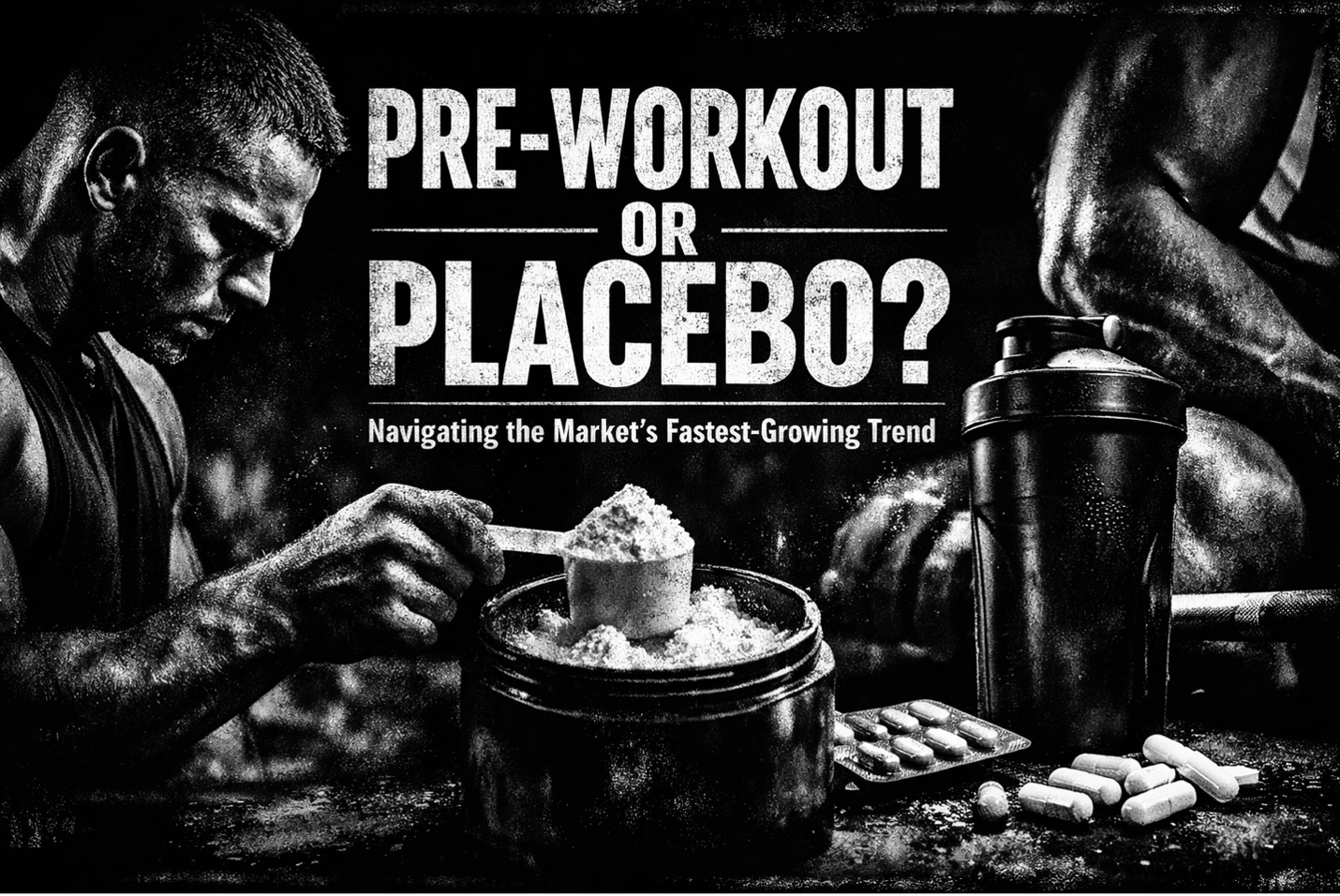
Walk into any gym in Colorado Springs, and you’ll smell it before you see it. No, not the sweat: the overwhelming scent of "Blue Raspberry" or "Nuclear Watermelon" wafting from a shaker bottle.
Pre-workout supplements are currently the "it" girl of the fitness world. By 2030, the market is projected to hit nearly $28 billion. It’s a massive industry built on the promise of skin-splitting pumps, laser focus, and enough energy to deadlift a house. But here’s the kicker: when we put together our list of the top 5 supplements that actually work, pre-workout was noticeably absent.
Why? Because while individual ingredients are rockstars, the "proprietary blends" found in most colorful tubs are often more marketing magic than physiological miracle. Today, we’re cutting through the neon-colored noise to see if your scoop is actually doing something or if you’re just paying for a very expensive case of the jitters. ⚡️
The Hype vs. The Reality (Marketing vs. Science)
Let’s be real: the marketing for pre-workouts is elite. They use words like "Anabolic," "Explosive," and "Primal." It makes you feel like you’re preparing for a Spartan gladiator match rather than a Tuesday morning session at a performance run gym.
The reality is a bit more nuanced. Most pre-workouts fall under the category of Multi-Ingredient Pre-Workout Supplements (MIPS). Recent research in the Strength and Conditioning Journal suggests that while MIPS can improve power and strength, the evidence is often "weak" or "inconsistent" because every brand uses different dosages 2.
The problem? Companies often hide behind "proprietary blends." This is a legal way of saying, "We put a bunch of stuff in here, but we aren't going to tell you exactly how much of each." Usually, this means they’ve sprinkled in a tiny amount of the expensive stuff (like Citrulline) and loaded it with the cheap stuff (Caffeine and fillers).
At WorkTime, we’re big on disciplined training and transparent nutrition. If you don't know exactly what's going into your body, how can you track what's actually working?

What’s actually in that scoop?
If we strip away the flashy labels, most effective pre-workouts rely on three heavy hitters. If your supplement doesn't have these in the right doses, you might as well be drinking a soda.
1. Caffeine: The Heavy Lifter
Caffeine is the MVP. It reduces your perception of effort, meaning that a heavy set of five during a strength or power routine feels more like a set of three. It’s tried, true, and incredibly effective. But here's the catch: many tubs contain 300mg to 400mg per scoop. That’s about four cups of coffee in one go. Great for energy, not so great for your heart rate (more on that later).
2. Citrulline Malate: The "Pump."
Ever wonder why your muscles look bigger mid-workout? That’s vasodilation. Citrulline increases nitric oxide in the blood, which relaxes your blood vessels and improves blood flow to the working muscle. To actually get the performance benefit, you usually need 6–8 grams. Most pre-workouts give you about 1–2 grams. Math is hard, but marketing is easy.
3. Beta-Alanine: The Tingle
This is the stuff that makes your face itchy. Beta-alanine helps buffer lactic acid, which theoretically lets you squeeze out those last two reps. However, it’s a cumulative supplement: meaning you need to take it daily for weeks to see a benefit, not just right before you hit the gym.
The Over-40 & Youth Athlete Safety Check
This is where we need to get serious. We love seeing older athletes crushing it: in fact, we wrote a whole guide on outsmarting age-related decline. But if you’re over 40 or training a youth athlete, pre-workout requires a massive "Proceed with Caution" sign.
Recent integrative reviews have highlighted significant cardiovascular risks associated with high-stimulant MIPS 1. We're talking about:
Acute increases in blood pressure.
Heart palpitations.
Increased risk of arrhythmias.
For our youth athletes, the risks are even higher. Developing nervous systems and high doses of caffeine don't mix well. There is a real concern regarding the long-term impact of these supplements on cardiovascular health 3.
If you’re training here at WorkTime, we’d much rather see you focus on smart meal timing than relying on a chemical cocktail to get you through a session.

WorkTime’s "Food-First" Alternative
We aren't "anti-supplement," but we are "pro-science." If you want the benefits of a pre-workout without the mystery powder and the heart palpitations, we recommend a food-first approach.
Here is the WorkTime "Pre-Workout" stack:
Beet Juice (The Natural Citrulline): Beets are loaded with dietary nitrates. They do exactly what Citrulline does: improve blood flow and oxygen delivery to the muscles. Drink a glass 90 minutes before your workout. (Fair warning: your pee might turn pink. Don’t panic!)
Black Coffee (The Clean Caffeine): You know exactly how much you're getting, it's rich in antioxidants, and it won't cost you $60 a tub. Plus, it doesn't taste like a melted popsicle.
A Banana or Simple Carb: Most people "crash" mid-workout because they are low on glycogen, not because they lack a "focus complex." Pair your coffee with some fruit for sustained energy.
Salt: A pinch of high-quality salt in your water can do wonders for your hydration and muscle contractions.
If you’re still craving that "treat" feeling, why not try something that actually fuels your recovery? Our high-protein ranch dip or one of my favorites, homemade protein ice cream, is a better investment for your long-term gains.

The Verdict: Is it Worth It?
If you’re an experienced lifter/athlete at one of the local gyms and you’ve found a third-party tested brand that works for you, cool. Use it sparingly.
But for most of us? It’s a placebo with a side of caffeine jitters.
At WorkTime Athletic Performance, we believe discipline beats "hype" every single day. You don't need a proprietary blend to work hard; you need a plan, a good night's sleep, and the right fuel.
Got questions about your specific supplement stack? Come chat with us at the gym or check out our classes to see how we build performance from the ground up: no neon powders required. 👊
AMA Citations
Bella YF. Pre-Workout Supplements and Their Effects on Cardiovascular Health: An Integrative Review. J Cardiovasc Dev Dis. 2025;12(4):112.
Bobos P, Nazari G, Ziebart C, et al. A Systematic Review and Meta-analysis of the Effect of Multi-Ingredient Pre-Workout Supplements on Strength and Power. Strength Cond J. 2021;43(1):37-62.
Corbett LJ, Bunch MR, Smith MB, et al. An Overview of the Risks and Impact of Pre-exercise Supplements for Exercise Performance, Recovery, and Cardiovascular Health. Curr Cardiovasc Risk Rep. 2024;18:1-12.